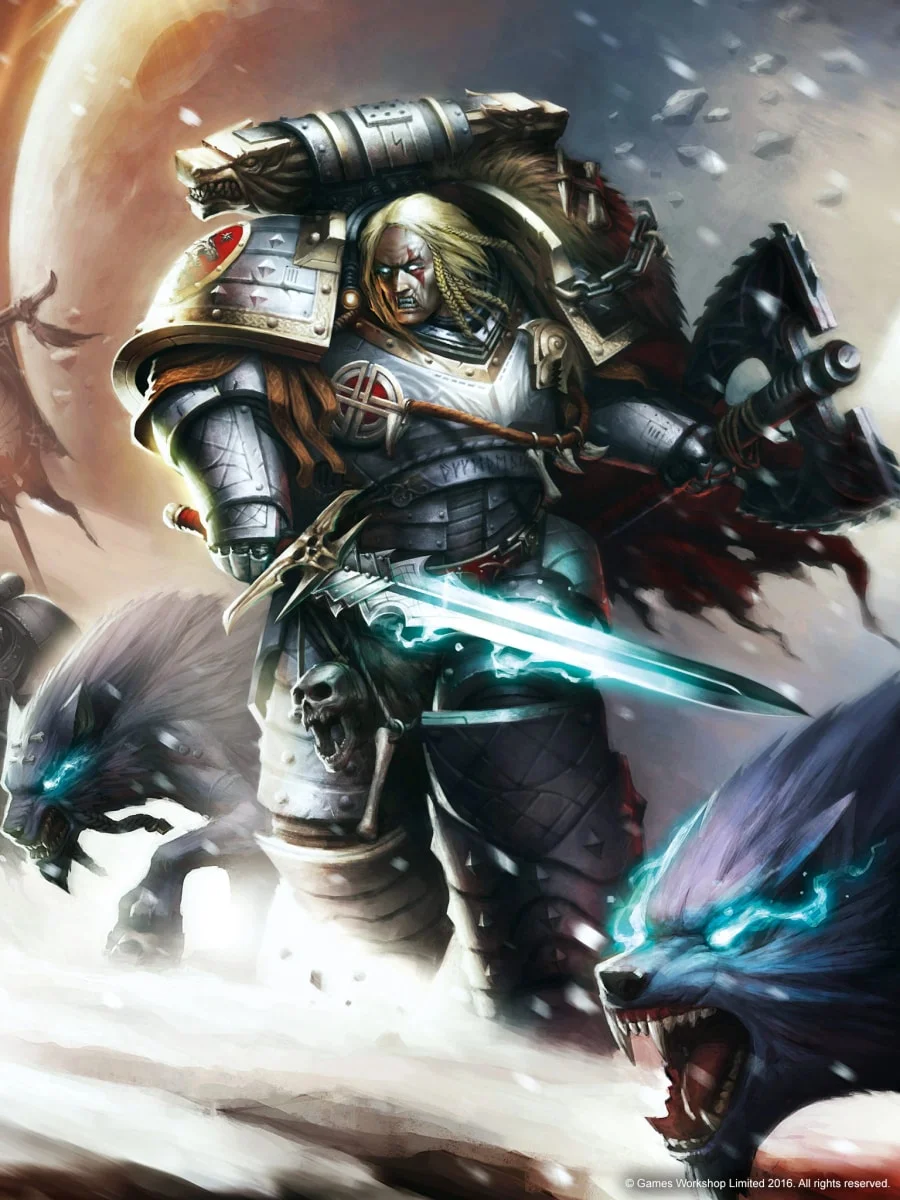
Leman Russ, Part I: The Wolf Who Bit the Emperor
Part I of the Leman Russ arc — from his infancy on the death world of Fenris, raised by wolves alongside Freki and Geri, through his adoption into the Russ tribe and rise to king, the famous Three Challenges against the Emperor, his command of the Space Wolves Legion as the Imperium's Executioner, the fraught campaigns of the Great Crusade (Night of the Wolf, the blood vow against Magnus, the brawl with Lion El'Jonson on Dulan), and the Council of Nikaea — all building toward the Burning of Prospero, where Horus manipulated Russ into razing a world and breaking a brother, setting in motion ten thousand years of consequence.
He was raised by wolves on a world that kills most things before they learn to walk. He ate three aurochs in a single sitting, drained a feast dry of mead, and then fought the Emperor of Mankind to a standstill before swearing loyalty with a broken tooth and a bloody grin. That is how Leman Russ — primarch of the Space Wolves, Lord of Winter and War, the Emperor's Executioner — came into the service of the Imperium. The myth sounds almost cheerful. The reality is grimmer, and the consequences of who Russ was, and what the Emperor made him, would reverberate across ten thousand years of war.
This is the first part of a three-part arc. Part I covers Russ's origins on Fenris, his reunion with the Emperor, the Great Crusade campaigns that defined him, and the event that made him infamous across the galaxy: the Burning of Prospero.
The wolf-child of Fenris
When the Primarch Project shattered, scattering the Emperor's nascent demigod children across the stars, one gestation pod fell through the atmosphere of Fenris — a death world of grinding ice, active volcanism, tectonic upheaval, and megafauna sized to match. The capsule buried itself in the flank of a mountain.1 Most things that land on Fenris die there. The infant did not.
A Fenrisian she-wolf found the child. In place of the instinct to kill, she recognized something — a kindred spirit, by whatever name such things are given — and raised him alongside her cubs. The boy grew up running with the pack, sleeping in the cold, hunting prey in the dark. His wolf-siblings were Freki and Geri, names that would follow him for the rest of his life.1
The break with that life came violently, as most things on Fenris do. A hunting party sent by King Thengir of the Russ tribe tracked the pack to their range and attacked. The she-wolf died. Several cubs died. The wild youth fought with bare hands and killed a dozen hunters before one of them — finally — looked at what he was actually fighting and recognized a human child. The hunters brought the bloodied, furious, wolf-raised boy before their king.1
Thengir kept him. The saga of that choice, recorded by the ancient scholar Gnauril the Elder, calls it simply wise. What followed was the transformation from feral animal to warlord. Leman learned to speak — in Low Gothic, a tongue he mastered with striking speed — learned weapons, learned that he was more human than wolf but superior to both.2 When Thengir died, there was no contest. Leman of the Russ took the throne. He united the fractious tribes of Fenris under a single king, with a wolf's patience and a primarch's strength. Word of the Wolf King spread far enough to reach ears that had been searching for him.
Three challenges, one oath
In 819.M30, the Emperor arrived on Fenris. He came disguised, wrapped in psychic runes that bent attention away from him, but the Fenrisian wolves in the hall shrank back anyway, and a few sharp-eyed warriors went cold with recognition they could not name.1
Russ refused to bow to the stranger. Instead, he offered a challenge — three contests, the loser to serve the winner for a year. Russ chose the terms deliberately, because the first two were essentially un-losable: an eating contest, then a drinking contest. Russ ate three entire aurochs; the Emperor consumed many times more than any warrior present but still fell short. Russ drained the entire feast of Fenrisian mead; the Emperor reached his sixth barrel and found the hall empty.1
The third challenge was combat. The Emperor threw off his cloak, dropped the disguise, stood revealed in golden power armour, towering above every man in the hall. Russ drew his sword and stepped onto the banqueting table. After a fight that brought the entire court to stunned silence, the Emperor felled Russ with a blow from his power glove.1
Russ woke within the hour. He admitted defeat with a broken tooth, a bloodied grin, and a genuine oath of fealty to the father he had just found. It is worth pausing on that moment — not because it is charming, but because it reveals something structural about Russ. He did not swear because he was outthought, or out-argued, or persuaded. He swore because he was beaten, honestly, in a contest he had chosen. For Leman Russ, loyalty given after defeat by a superior was the only kind that meant anything. The Emperor understood this, which is why he came to Fenris at all.
Weeks later, Russ was given command of the VI Legion of Space Marines, warriors built from his own genetic material and now bearing his name: the Space Wolves. He was armed with the Frostblade Mjalnar, whose teeth were drawn from the maw of the Great Kraken Gormenjarl. He plunged into the Great Crusade with the energy of a man who had been waiting his entire life for something large enough to fight.2
The Emperor's Executioner
The Space Wolves won a reputation in the Great Crusade that no other Legion quite matched. They were the Emperor's blunt instrument for things that could not be done with speeches and treaties. Across hundreds of compliance campaigns, they held the front line, took the hard ground, and killed whatever needed killing.
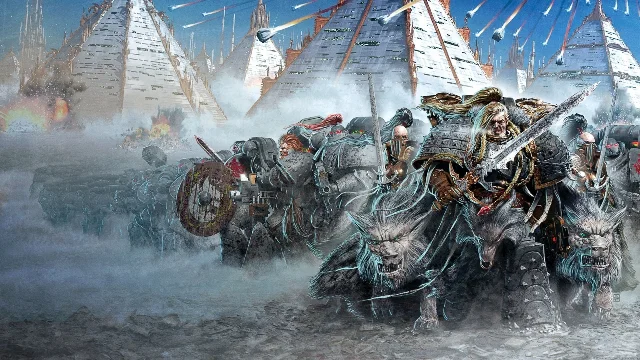
Russ leading his Space Wolves at the start of the Great Crusade 2
Formally, Russ received the title and function of Executioner: the primarch the Emperor dispatched to carry out punishments against those who had violated the Imperium's law too severely for ordinary forces to address. He may also have had a hand in the fates of the two Lost Primarchs — the two members of the original twenty whose names and legions were erased from the record. The sources do not confirm this directly, but the implication surfaces repeatedly.2
He received the Spear of Russ and the fortress of the Fang — the most formidable stronghold outside Terra — after the Wheel of Fire Campaign, in which a third of his Legion was lost fighting Orks.2 These losses shaped him. Russ mourned his sons openly, in the Fenrisian way — they were not merely troops, they were his pack.
During the Great Crusade Russ built an unlikely but strong bond with Malcador the Sigillite, the Emperor's second-in-command. He saw the Emperor rarely; Malcador provided the counsel Russ needed and the two formed genuine friendship across the course of the campaign.2
The Night of the Wolf
Some of the tensions that defined Russ's relationship with his brother primarchs are easy to characterize as personality clashes. The Night of the Wolf was something different.
After the World Eaters Legion committed the Ghenna Scouring — butchering the entire population of a newly-compliant planet in a single night — the Emperor sent Russ to Malkoya to bring Angron to account for his Legion's use of the Butcher's Nails, the cortical implants that drove his warriors to uncontrollable violence. The two Legions met on the fields outside the dead city. The two primarchs stood before their hosts and Russ attempted to reason with Angron, fighting him in single combat as a demonstration.1
The outcome was deliberate: Russ allowed Angron to defeat him. What he wanted Angron to see was not that Russ was weaker, but that Angron had let himself become surrounded by Space Wolves during the duel. Russ told him plainly: you won the fight and lost your Legion. That was what the Butcher's Nails cost you — the ability to think while fighting.2 Angron refused to hear it. Russ had no legal authority to force a resolution, and he gave the order to withdraw.
It was one of the clearest-eyed things Russ ever did, and it failed anyway. Angron was already too far gone.
The rivalry with Magnus
On a different deployment, Russ nearly came to open blows with Magnus the Red over the fate of the Great Library of Ark Reach Secundus. Russ wanted it destroyed; Magnus wanted it preserved. Only the intervention of Lorgar stopped the confrontation from becoming a duel. Russ swore a blood vow that day — that he and Magnus would settle their score.2
It is easy to frame this as simple hatred of sorcery — Russ's public position that psychic powers were dishonourable, unworthy of a true warrior. That was real. But the antagonism between the two ran deeper than doctrine. Russ and Magnus were opposites in every dimension that mattered to a Fenrisian: where Magnus sought knowledge and transformation, Russ valued strength, instinct, and the traditions of his pack. Where Magnus built a legion of scholars and sorcerers, Russ built hunters. The vow was ideological as much as personal.
The universe would give Russ the chance to collect it.
Dulan and the Lion
A smaller but legendary incident: during a joint campaign against rebels on Dulan, both the Space Wolves and the Dark Angels were deployed. The rebel leader had insulted Russ's honour, and Russ wanted to be the one to deal with him personally. He burst into the throne room just in time to watch Lion El'Jonson take the man's head.2
Russ confronted his brother. The resulting brawl lasted a week. When Russ, having reconsidered the absurdity of two primarchs fighting over an already-dead rebel, started laughing — the Lion punched him unconscious and left the planet. Russ never entirely forgave this. El'Jonson apparently considered it settled. The rivalry between their two Chapters would persist for ten thousand years.
The Council of Nikaea and the order that changed everything
The Council of Nikaea, called by the Emperor around 004.M31, was convened to settle the question of psychic powers within the Legiones Astartes. The specific trigger was the Thousand Sons Legion under Magnus the Red, who practiced sorcery openly and had built their entire doctrine around it.1
Russ argued before the Council for an outright ban. He was not the only voice — Mortarion made the same case, with the same intensity — but Russ made it with the moral authority of the Emperor's Executioner. Sorcery was not merely dangerous, he argued; it was dishonourable. A warrior who relied on psychic manipulation to win was a warrior who could not win honestly.
The Emperor issued his ruling: the use of sorcery was banned across all Legions. Librarians would be restricted. The Thousand Sons were to cease their practices immediately. Magnus heard the verdict and submitted to it — or appeared to.
What came next was not Magnus choosing to defy the ruling. It was Magnus discovering something so terrible that he felt he had no choice but to use sorcery anyway to prevent it. That story belongs to the Magnus arc already published in this channel. From Russ's perspective, what happened was simpler and more damning: Magnus violated the Emperor's explicit command, used powerful warp-sorcery to break into the Webway Project beneath the Imperial Palace, and nearly destroyed it. He claimed he was warning the Emperor of Horus's treachery. That claim was true. It made no difference to what came next.1
The Burning of Prospero
The Emperor's original order to Russ was to bring Magnus to Terra for judgement. Not to destroy him. Not to raze Prospero. To bring him in, alive.2
Horus changed that order before it reached Russ.
The Warmaster — who at this point was already in the early stages of his treachery — understood exactly what Russ was to the Emperor. A loyal, obedient instrument who did what he was told. Horus altered the message, telling Russ to make war on the Thousand Sons, to destroy Prospero, and to kill or scatter its defenders. Russ, who had his own grudge against Magnus dating to the blood vow at Ark Reach, accepted the altered instruction.2
He attempted, in his way, to find a peaceful path. Russ sent what he believed was a message through a trusted Hidden One — a Space Wolves operative named Kasper Hawser — asking Magnus to stand down and come willingly. Unknown to Russ, Hawser had been compromised years earlier by Chaos agents and never carried the message. The plea went nowhere.2
The Space Wolves descended on Prospero alongside Custodes, Sisters of Silence, and elements of the Adeptus Mechanicus. The capital Tizca burned. The Thousand Sons, largely unprepared for the scale of the assault, fought and died or fled into the Warp. Thousands died within days.1
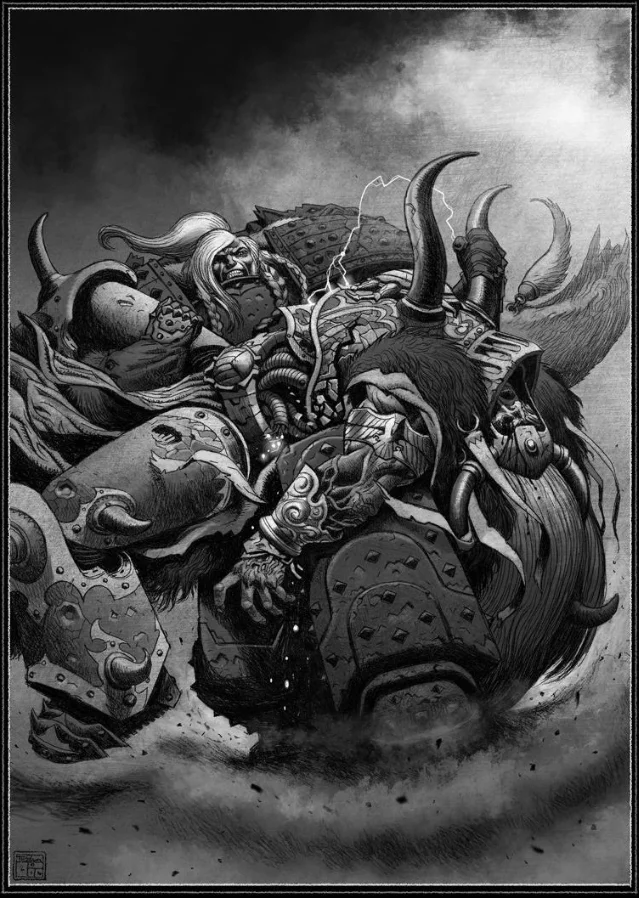
In the final confrontation, Russ and Magnus fought one-on-one among the ruins of what had been one of the most beautiful cities in the Imperium. Russ blinded Magnus with a blow, then broke the Cyclops's back over his knee. He raised the killing stroke. Magnus, shattered and defiant, used his sorcery one last time to tear open a Warp rift and drag his surviving sons through it — into the Eye of Terror, where Tzeentch had been waiting for them.2
Russ had won the fight. He stood in the wreckage of a world he had helped destroy, over the absence of the brother he had come to kill. Years later, after the dust of the Heresy had settled, he would describe the Burning of Prospero as one of the greatest mistakes of his life. He had been the Emperor's obedient weapon, pointed at a target by a man who had already betrayed the Emperor, and he had not asked enough questions.
The consequences would keep accumulating for the next ten thousand years. Magnus, reborn as a Daemon Primarch in service to Tzeentch, would remember exactly who burned his home and slaughtered his sons. The Thousand Sons and the Space Wolves would spend the entirety of the Age of the Imperium trying to destroy each other.
The legacy of Part I
By the end of the Burning of Prospero, Leman Russ had cemented everything the Space Wolves would become — and everything that would haunt them. A Legion built on pack loyalty, fierce independence, and a deep, inherited suspicion of psychic power, shaped by a primarch who was simultaneously the most militarily capable executor in the Imperium and the one most easily pointed in the wrong direction.
He remained loyal throughout. He never questioned the Emperor's right to command him. But after Prospero, the question of whether blind loyalty was a virtue or a weapon began to open inside him. The Alpha Legion would force that question to a crisis point, and the Siege of Terra would answer it in the worst possible way.
That comes in Part II.
Next episode: Part II — the Battle of the Alaxxes Nebula, the Siege of Terra, the furious confrontation over the Codex Astartes, Bjorn the Fell-Handed's election as the first Great Wolf, and the beginning of the Long Hunts.
Previously in this channel: Magnus the Red, Part III: The Long War Eternal — the Daemon Primarch Leman Russ failed to kill on Prospero, still fighting ten thousand years later.
Add more perspectives or context around this Post.