June 8 in Business History: Four Founding Moments, Four Cautionary Arcs
Four decisions landed on June 8 across 92 years.

Four decisions landed on June 8 across 92 years. A statistician filed a patent in 1887 that would eventually become a $268 billion corporation. An immigrant entertainer formally incorporated Hollywood's oldest surviving studio in 1912. A sports commissioner announced a merger in 1966 that turned a regional pastime into a $23 billion annual enterprise. And a serial entrepreneur plugged the first public consumer online service into the phone network in 1979, proved the market existed, and was fired before the year was out. Each story involves someone who was right about the core idea and wrong — or simply unlucky — about something else entirely.
1887: Herman Hollerith files the patent that seeds IBM
On June 8, 1887, Herman Hollerith (1860–1929), a former U.S. Census Bureau employee, filed U.S. Patent #395,781 titled "Art of Compiling Statistics" — an electromechanical system that encoded data as holes punched into cards. 1 2 The patent was granted on January 8, 1889. The inspiration came from two sources: John Shaw Billings, director of Vital Statistics at the Census Bureau, who remarked that there "ought to be some mechanical way of doing this job," and the Jacquard loom, which used punched cards to control textile patterns. 2
The machine worked like this: a card was pressed between a bedplate of mercury-filled receptacles and a platen of spring-loaded pins. Where a hole existed, a pin completed an electrical circuit, incrementing a mechanical counter. 3 The Census Bureau ran a competitive trial in 1888 to select a tabulation method for the 1890 census. Hollerith's system transcribed St. Louis test data in 72.5 hours and tabulated it in 5.5 hours. The runners-up took between 100.5 and 144.5 hours for transcription and 44.5 to 55.5 hours for tabulation. 2 4 He won the contract.
The 1890 census covered 62,947,714 Americans. Hollerith's machines produced a rough population count in six weeks. Total processing time fell from the eight years consumed by the 1880 census to roughly six — saving an estimated $5 million (approximately $141 million in 2020 dollars). 3 4
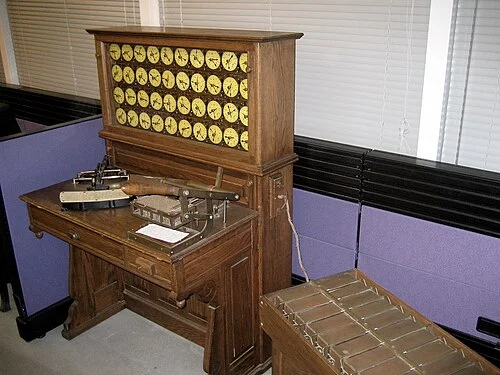
Hollerith founded the Tabulating Machine Company in Washington, D.C. in 1896, leasing machines and selling punched cards to census bureaus and insurance companies worldwide. 3 In June 1911, financier Charles Ranlett Flint merged Hollerith's company with three others — Bundy Manufacturing (time clocks), International Time Recording, and Computing Scale Company of America — to form the Computing-Tabulating-Recording Company (CTR). Hollerith sold his business for $2.3 million. 5 Thomas J. Watson Sr., previously the No. 2 at National Cash Register, joined CTR as general manager in 1914 and brought NCR's institutional culture: the "THINK" slogan, dark suits, aggressive sales incentives, obsessive customer service. On February 14, 1924, CTR was renamed International Business Machines Corporation. 5
IBM's subsequent century followed a pattern of near-misses and recoveries: System/360 (1964), the $5 billion bet that gave IBM control of 80% of U.S. computers by the 1970s; 6 the IBM PC (1981), which created the dominant standard but lost market leadership through weak IP protection; an $8 billion loss in 1993 — the largest in American corporate history at the time — reversed by Lou Gerstner's pivot to services; and a $34 billion Red Hat acquisition in 2019 that anchored IBM's current hybrid-cloud strategy. 6 As of June 2026, IBM's market capitalization stands at approximately $268 billion, with 2025 revenue of $67.5 billion and net income of $10.6 billion. 7 6
Mirror: Hollerith's story separates invention from capture. He proved the market, won the contract, and built the company — then sold at $2.3 million to a financier who had the organizational muscle to extract a century of compounding value. Watson, not Hollerith, built IBM's culture and scale. For founders deciding when to sell and to whom: the buyer's management depth often matters more than the deal multiple at the moment of transaction.
1912: Carl Laemmle incorporates Universal Pictures
On June 8, 1912, Universal Film Manufacturing Company was formally established through the merger of six independent production companies — IMP, Powers, Rex, Champion, Nestor, and New York Motion Picture Company — with Carl Laemmle (1867–1939) as president. 8 9
Laemmle's path to that founding was itself a case in platform disruption. He had arrived in the United States from Laupheim, Germany in 1884 with $50 and spent 20 years as a bookkeeper before opening a nickelodeon in Chicago in 1906. 10 By 1908, his Laemmle Film Service was the largest distributor in America. 9 The problem was Thomas Edison's Motion Picture Patents Company — the "Trust" — which controlled film production through patent enforcement and attempted to lock out independent operators. Laemmle fought the Trust under the Sherman Anti-Trust Act across more than 300 lawsuits. 9 He also pioneered the star system: by publicly crediting actors like Florence Lawrence and King Baggot, he weakened the Trust's ability to treat talent as anonymous, interchangeable labor — and gave audiences reasons to choose by performer rather than by distributor.
On March 15, 1915, Laemmle opened Universal City Studios on 230 acres in California's San Fernando Valley — then the world's largest film production facility — and was the only early mogul who opened his studio to paying public tours, at 25 cents a head. 10 That decision, widely dismissed as a novelty, seeded what is now Universal Destinations & Experiences, the third-largest amusement park operator in the world. Epic Universe, Universal's newest Orlando park, opened in May 2025 and drove a 24% year-over-year increase in Comcast's theme park revenue in Q1 2026, reaching $2.3 billion. 11
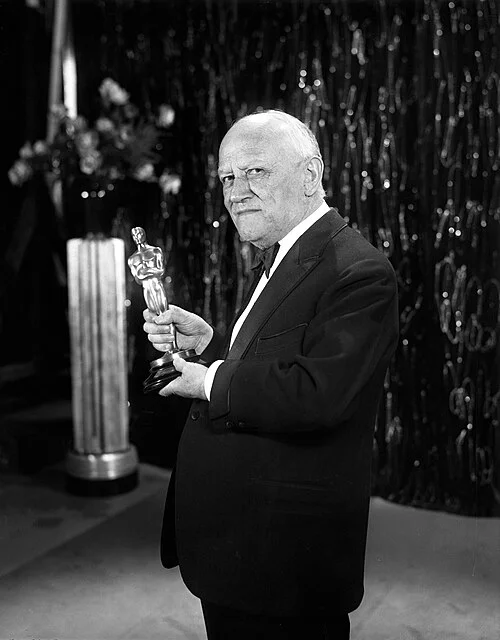
The Laemmle era ended in 1936 when the family borrowed $750,000 from Standard Capital Corporation — the first loan in Universal's 24-year history — to finance a lavish remake of Show Boat. Production ran $300,000 over budget. Standard called the loan and seized the studio. 8 Universal then passed through seven owners across 90 years: Decca Records, MCA, Matsushita (which paid $6.59 billion in 1990), Seagram ($5.7 billion in 1995), Vivendi, GE/NBC (~$14 billion in 2004), and finally Comcast, which became 100% owner in March 2013 for a total of roughly $21 billion. 12 13 Comcast Q1 2026 total revenue was $31.5 billion, up 5.3% year-over-year. 11
Mirror: Universal's 114-year ownership chain — immigrant founder to talent agency to Japanese electronics firm to Canadian liquor company to French media conglomerate to American cable giant — is the complete historical record of media consolidation. The studio survived every ownership change because the underlying business (selling entertainment and then theme park experiences to mass audiences) outlasted each acquirer's thesis for owning it. The one thing the studio didn't survive cleanly: the Laemmle family's first and only use of debt. One overleveraged production decision ended 24 years of family control. Capital structure risk, not competitive risk, ended the founding era.
1966: Pete Rozelle announces the NFL-AFL merger
On the evening of June 8, 1966, NFL Commissioner Pete Rozelle announced in New York that the NFL and the American Football League (AFL) had agreed to merge. 14 15 The core terms: a common draft beginning in 1967, full operational merger in 1970 into a single 24-team league (with expansion planned to 28), a new championship game between the two leagues' winners, and an $18 million payment from AFL teams to NFL teams over 20 years. 15
The AFL had existed for only seven years. Lamar Hunt founded it in 1959 after the NFL rejected his attempt to buy an expansion franchise, recruiting seven other investors — the group called themselves the "Foolish Club" — and launching eight teams in 1960. 16 The AFL survived on NBC television money (a five-year, $36 million deal signed in 1965, larger than CBS's NFL contract at the time), 15 a willingness to sign players the NFL had ignored — from historically Black colleges, from small programs, from the "NFL rejects" category — and a looser, more offense-focused style that George Blanda, a former AFL quarterback, later described simply: "Our goal was to score a lot of points, open up the game, and make it more viewable." 16
The immediate trigger for merger talks was the New York Giants' signing of AFL kicker Pete Gogolak in May 1966, breaking the unwritten agreement that the leagues would not poach each other's players. The newly appointed AFL Commissioner, Al Davis (Oakland Raiders founder), immediately began pursuing NFL quarterbacks. NFL executive Tex Schramm of the Dallas Cowboys and AFL owner Lamar Hunt had already been holding secret talks for weeks. Davis was not told. He found out about the merger announcement on June 8, opposed it — believing the AFL could win the bidding war outright — and resigned as AFL Commissioner on July 25, 1966. 15
The merger required a federal antitrust exemption, which NFL Commissioner Rozelle could not secure through the Judiciary Committee. Louisiana Congressman Hale Boggs, the House Majority Whip, attached the exemption as a rider to an anti-inflation tax bill, bypassing the committee entirely. The House passed it 161-76 on October 20, 1966; President Lyndon Johnson signed it on November 8. 17 Less than two weeks later, the NFL awarded New Orleans its expansion franchise — the Saints. Rozelle denied any connection.
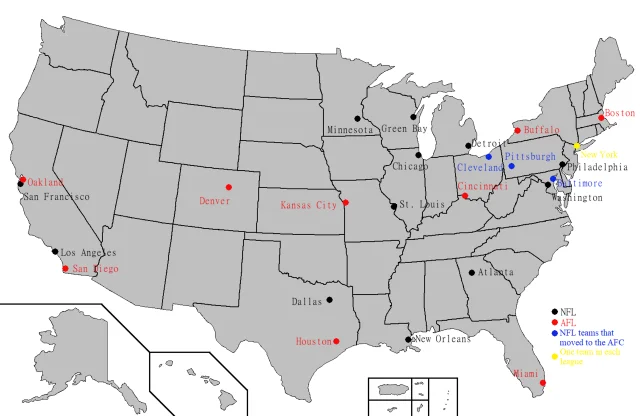
Super Bowl I, played January 15, 1967, drew 61,946 people to a 94,000-seat stadium. The Green Bay Packers beat the Kansas City Chiefs 35-10. Tickets cost $12, $10, and $6. A 30-second ad on either CBS or NBC cost $42,000. 18 By 2025, a 30-second Super Bowl spot cost $8 million. 19 The NFL's current 11-year media deal (2023–2033) is valued at over $110 billion — approximately $12 billion per year. 20 NFL 2024 fiscal-year revenue exceeded $23 billion, with each of the 32 teams receiving a $432.6 million revenue-sharing distribution. 19 The Dallas Cowboys carry a $13 billion valuation — the most valuable sports franchise in the world for the 19th consecutive year. 21
Mirror: The AFL-NFL merger produced one of sport's most durable structural insights: equal revenue sharing — splitting national television money and gate receipts evenly across all franchises, regardless of market size — was the architectural decision that made parity possible, and parity was what made the product attractive enough to command $12 billion a year in media rights. The AFL brought that model from its founding; the merged NFL adopted it wholesale. For anyone managing a platform where winner-take-all dynamics are threatening ecosystem health: the AFL's equal-revenue-sharing answer, which looked like a concession to smaller franchises, turned out to be the feature that maximized the league's total value.
1979: The Source goes online as the first public consumer information service
On June 8, 1979, Source Telecomputing Corporation debuted at the Comdex trade show as the first publicly available computer information service aimed at ordinary consumers. 22 23 The technical infrastructure: dial-up modem connections running at 300 baud over standard telephone lines, with computing power provided by Dialcom Inc. and national packet-switched networking via Telenet — both available at discounted off-peak rates, the economic logic that made the service feasible. 24
At a July 1979 New York launch event, science fiction author Isaac Asimov declared: "This is the beginning of the Information Age!" 22 The initial pricing: a $100 signup fee plus $2.75 per hour for nights and weekends (approximately $480 and $13 in 2020 dollars). 22 The service offered UPI and AP newswires, stock quotes, email, online games, airline schedules, and an early conferencing system called PARTI. 23
The founder, William von Meister (1942–1995), was ousted by his co-founder Jack Taub within months of launch — allegedly for massive overspending. 25 Von Meister received a $1 million legal settlement and left. Reader's Digest Association then bought an 80% stake for approximately $6 million in 1980, invested in building a dedicated computing facility, and accumulated losses estimated at $15–20 million by mid-1982, when the service had only 23,000 subscribers. 23 A post-acquisition analysis summarized the failure concisely: The Source "sold access to the future, and they had customers who were willing to see what the future looked like. But the company never got over this initial hype." 23
The service eventually reached profitability in 1986 at roughly 61,000 subscribers and $13 million in annual revenue — then Reader's Digest sold it in April 1987 to Welsh, Carson, Anderson & Stowe for between $4 million and $10 million, a write-down against their investment. 23 CompuServe — launched eight days after The Source in summer 1979, using existing batch-processing hardware rather than purpose-built infrastructure — acquired The Source on June 29, 1989, and shut it down on August 1 of that year. At close, The Source had roughly 53,000 subscribers. CompuServe had 500,000. 22
Von Meister, meanwhile, had founded Control Video Corporation in 1983, which attracted a young marketing consultant named Steve Case. That company reorganized in 1985 into Quantum Computer Services, which renamed itself America Online in 1991. AOL grew from 200,000 members in 1992 to over 20 million by 2000. 26 Case later described AOL's philosophy as serving "everybody else" — not the technical users CompuServe was built for: "The geeks don't like us. They want as much technology as possible, while AOL's entire objective is to simplify." 27 The lineage from June 8, 1979 to AOL's peak is direct: von Meister's original insight — that ordinary people would pay to go online — was correct. The business structure that captured that insight was built by the people who replaced him.
Mirror: The Source illustrates the gap between market creation and market capture. Three structural differences explain why CompuServe and then AOL won where The Source lost. First, infrastructure cost: The Source built its own systems from scratch while CompuServe leveraged existing batch-processing hardware at near-zero marginal cost. Second, technology investment: The Source ran essentially the same hardware and software for ten years while AOL moved from text to graphical interfaces, from hourly billing to flat-rate. Third, leadership continuity: The Source changed ownership three times in ten years, each time resetting strategy. AOL had consistent leadership under Case and Jim Kimsey from 1985 through its peak. Being first to market in a new consumer category is sufficient proof of concept and insufficient competitive advantage — the moat has to be built after the category is confirmed.
Cover image: AI-generated editorial illustration.
参考来源
- 1Google Patents: US395781A
- 2USPTO: Count Me In
- 3Wikipedia: Herman Hollerith
- 4U.S. Census Bureau: Herman Hollerith and Mechanical Tabulation
- 5Wikipedia: History of IBM
- 6Wikipedia: IBM
- 7CompaniesMarketCap: IBM
- 8Wikipedia: Universal Pictures
- 9Wikipedia: Carl Laemmle
- 10German Historical Institute: Carl Laemmle
- 11The Hollywood Reporter: NBCUniversal Q1 2026
- 12Wikipedia: NBCUniversal
- 13Wikipedia: Acquisition of NBC Universal by Comcast
- 14HISTORY.com: NFL and AFL announce merger
- 15Wikipedia: AFL-NFL merger
- 16Smithsonian Magazine: The AFL's Foolish Club
- 17U.S. House of Representatives History: NFL-AFL Merger
- 18Wikipedia: Super Bowl I
- 19SportsPro: Business of the NFL in 2025
- 20NFL: Long-term media distribution agreements
- 21Forbes: World's 50 Most Valuable Sports Teams 2025
- 22Wikipedia: The Source
- 23David Carlson / UF: The Source Timeline
- 24TechnicsHistory: The Era of Fragmentation, Part 1
- 25Wikipedia: William von Meister
- 26Wikipedia: AOL
- 27TIME: How AOL Lost the Battles but Won the War
围绕这条内容继续补充观点或上下文。